

Creating a Control System: Synthetic Neurons, Wireless Communication, and Neural Interfaces
An Investigation Based on Published Peer-Reviewed Research

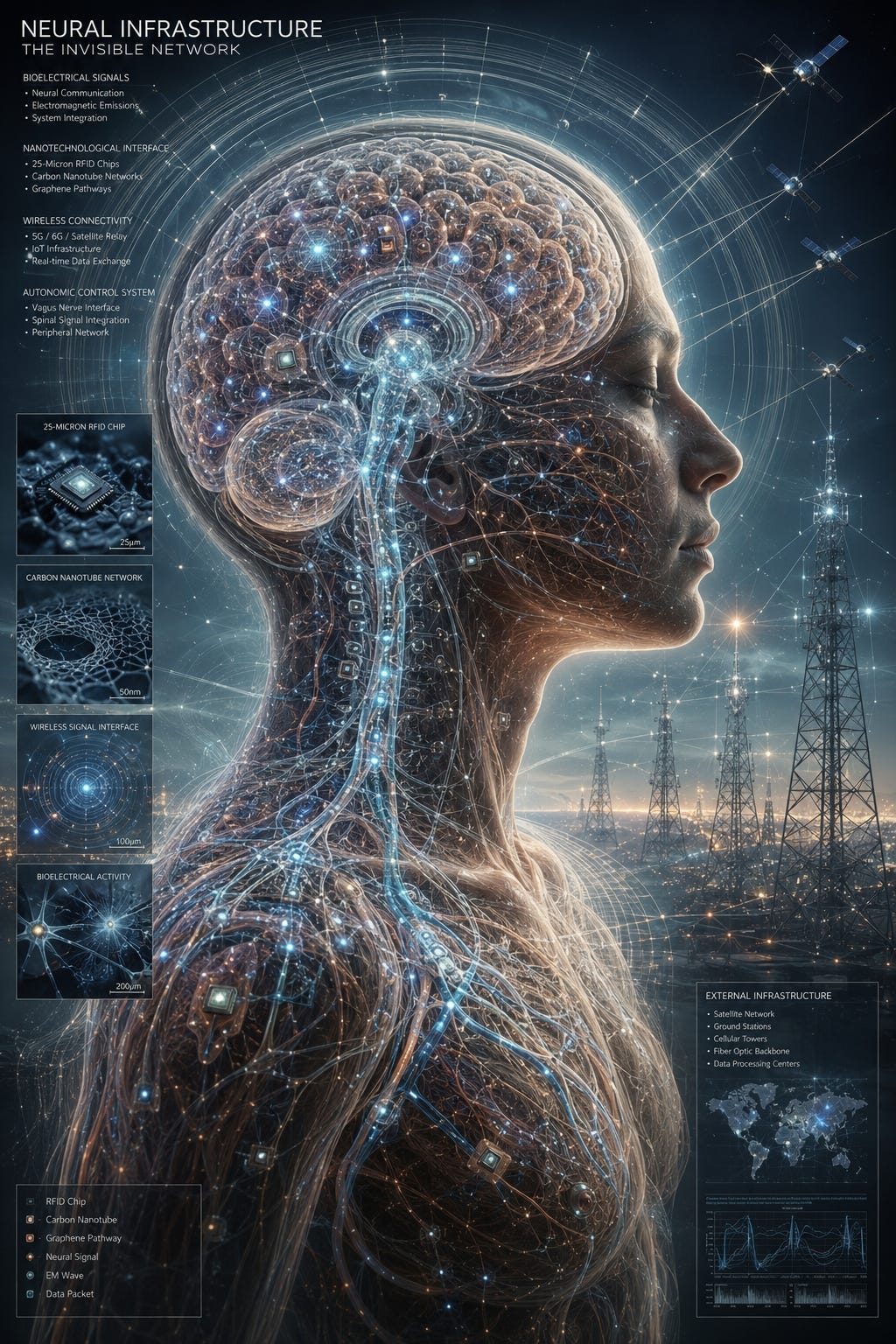
INTRODUCTION: The Technology Already Exists
In 2021, Stanford University published a research paper in Nature Scientific Reports demonstrating that 25-micrometer wireless RFID chips could be internalized by living cells and communicate with external receivers. The same year, the Korea Advanced Institute of Science and Technology (KAIST) published a comprehensive review in iScience documenting next-generation neural interfaces capable of “high-specificity recording and modulation” of neural activity. In 2020, a peer-reviewed paper in Bioelectronic Medicine detailed wireless peripheral neural interfaces, including carbon nanotube electrodes, magnetic stimulation coils, and self-powered systems that could modulate autonomic nerves—controlling organ function, immune response, and behavior—remotely via electromagnetic fields.
These aren’t theoretical. They’re documented. They’re published in mainstream scientific journals. They’re being developed at elite institutions with significant funding.
The uncomfortable question this article explores: What if these technologies were not intended for patients, but for populations?
This is not a conspiracy theory. It’s a logical extrapolation from published research combined with a sober assessment of how powerful technologies have historically been deployed.
PART 1: THE BUILDING BLOCKS ARE ALREADY HERE
Layer 1: Cellular-Level Wireless Communication
The Stanford Discovery (2021)
Researchers at Stanford’s Department of Electrical Engineering successfully demonstrated the first wireless detection and communication of an electronic device inside a living cell. Here’s what was actually achieved:
25 μm RFID devices small enough to be internalized by mammalian cells
Wireless external detection and identification of those devices while located intracellularly
Different “batches” of chips with distinct electrical signatures, allowing individual cell classification
Critical finding: Cancer cells showed uptake rates of 60-70% within 24-48 hours
This last point is important. The technology preferentially targets cancer cells. But cancer cells are cells with specific markers. Other cell types—immune cells, neurons, endocrine cells—have their own markers.
Implication: You could theoretically design RFID chips to target specific cell populations and track them remotely.
Layer 2: Neural Tissue Replacement
The Synthetic Neuron (University of Bath, 2019)
A silicon-based synthetic neuron was developed that:
Mimics biological neural firing patterns with perfect fidelity
Operates on 140 nanoWatts of power (one billionth that of microprocessors)
Can be implanted in the brain
Successfully modulated breathing and pacemaker rhythm in live animals
Received FDA interest for treating neurodegeneration
More recently, carbon nanostructures have been developed for the same purpose—replacing damaged neural tissue with synthetic equivalents that respond to external signals.
The question: If you can replace damaged neurons with synthetic ones that respond to external electromagnetic signals, you’ve fundamentally altered what a “brain” is. It’s no longer purely biological. It’s a hybrid system.
Layer 3: Remote Wireless Triggering Architecture
The Bioelectronic Medicine Stack (2020)
A comprehensive review paper in Bioelectronic Medicine documented the complete infrastructure for remote neural modulation:
Carbon nanotube electrodes: Chronically implantable (16+ weeks demonstrated), high signal-to-noise ratio, biocompatible
Wireless power transmission: Near-field communication (NFC) at 13.56 MHz and mid-field systems at ~1.5 GHz with 8% power transfer efficiency through tissue at 1 cm distance
Magnetic micro-coils: Implantable, remotely triggerable, enabling selective neural stimulation with micron-scale precision
Self-powered systems: Triboelectric nanogenerators that harvest energy from body movement and deliver neural stimulation without batteries
Multiple modulation modes: Electrical, ultrasonic, magnetic, and optical stimulation all documented and working
Translation: You can implant hardware that responds to external EM signals, requires no power source of its own, and can selectively stimulate specific neural populations.
Layer 4: Autonomic Nervous System Control
The Critical Infrastructure (Published Research, 2016-2021)
Documented applications include:
Vagus nerve stimulation: FDA-approved for treating depression, seizures, and chronic inflammation. Also controls heart rate, blood pressure, immune function, and digestion.
Bladder control: Remote modulation of pelvic nerves demonstrated in animal models
Immune modulation: Vagus nerve stimulation shown to reduce inflammatory markers in rheumatoid arthritis, Crohn’s disease, and sepsis
Metabolic control: VNS shown to affect appetite, obesity risk, and diabetes markers
Emotional regulation: Direct nerve stimulation affecting mood and behavior
The unstated implication in the research: If you can modulate the autonomic nervous system remotely, you can influence:
Fear and aggression
Appetite and satiety
Pain perception
Sleep cycles
Emotional states
Immune response
Inflammatory cascades
All of this is documented. All of it works. All of it can theoretically be done remotely via electromagnetic fields.
PART 2: THE INTEGRATION—BUILDING THE SYSTEM
Imagine a scenario where a powerful actor—a government, a transnational corporation, or an alliance of both—decided to integrate these technologies into a coherent control infrastructure. How would it work?
Phase 1: The Delivery Vector
The Medical Framing
In our scenario, the technology arrives not as an obvious surveillance system, but as medical treatment:
“Miraculous breakthrough in treating Alzheimer’s disease and dementia”
“New therapy for vaccine-resistant epilepsy”
“Chronic pain relief without opioids”
“Revolutionary depression treatment”
“Immune system optimization for pandemic protection”
All framed as therapeutic. All based on real research. All optional at first.
The delivery mechanism: Clinics. Hospitals. Mobile health units. Vaccination programs repurposed as implantation vectors.
The Technical Reality:
What’s actually being delivered:
Intracellular RFID tags (the Stanford technology) that spread through the body, preferentially accumulating in specific tissue types
Synthetic neural nodes (replacement neurons or neural interface nodes) positioned at strategic locations in the brain and peripheral nervous system
Carbon nanotube electrode networks interfacing with the autonomic nervous system
Triboelectric power harvesting systems embedded in muscle tissue, powered by natural body movement
The recipient thinks they’re getting treatment for a medical condition. What they’ve actually received is a wireless-enabled interface to their nervous system.
Phase 2: The Infrastructure
External Control Architecture
Simultaneously, a distributed infrastructure is built:
Transmission towers operating at approved frequencies (the research documents NFC at 13.56 MHz and mid-field systems at ~1.5 GHz—both approved for various applications)
Satellite systems providing global coverage
5G/6G infrastructure providing high-bandwidth communication
AI systems monitoring and analyzing neural signals from the population
Algorithmic control systems determining what signals to send to whom
The technology exists for all of this. The bandwidth is there. The frequencies are approved. The only missing piece is the will to do it.
Phase 3: The Control Mechanisms
How It Actually Works
Once the neural infrastructure is in place, what can be controlled?
Tier 1: Behavioral Modification
Direct stimulation of reward/punishment neural pathways
Subliminal messaging via auditory nerve stimulation
Fear induction through amygdala stimulation
Artificial arousal/fatigue cycles
Current research demonstrates: All of these are technically feasible with current technology. Vagus nerve stimulation already affects mood. Ultrasonic stimulation can target specific brain regions. Magnetic stimulation is FDA-approved for depression.
Tier 2: Biological Control
Immune suppression (vagus nerve modulation suppresses inflammatory cytokines—documented)
Metabolic acceleration or suppression (vagus nerve controls digestion and energy processing)
Sleep disruption or enforcement (hypothalamic modulation via synthetic neurons)
Hormone disruption (direct pituitary/endocrine modulation)
Pain sensation manipulation
Current research demonstrates: Vagus nerve stimulation affects rheumatoid arthritis, Crohn’s disease, obesity, diabetes. These aren’t theoretical—they’re FDA applications.
Tier 3: Cognitive Control
Attention manipulation (prefrontal cortex stimulation)
Memory suppression or enhancement (hippocampal interface—the research exists)
Emotional state enforcement (limbic system modulation)
Motivation control (reward pathway modulation)
Reasoning inhibition (dorsolateral prefrontal cortex suppression)
Current research demonstrates: Memory prosthetics already restore hippocampal function. Transcranial magnetic stimulation affects decision-making. These technologies are being tested right now.
Tier 4: Selective Population Control
The intracellular RFID technology allows individual identification and targeting
Different “signal profiles” could be transmitted to different people based on their demographics, location, behavior, or status
Dissidents receive different stimulation patterns than compliant populations
Resource allocation could be tied to neural compliance signals
This is the crucial integration point: You’re not controlling everyone the same way. You’re controlling specific populations with surgical precision.
PART 3: THE PLAUSIBLE SCENARIO
How It Would Actually Unfold
The Initial Rollout (Year 1-3)
A global pandemic (real or manufactured) creates urgency and fear. Governments mandate or heavily incentivize a new medical treatment that’s positioned as cutting-edge neurotechnology.
“This implant will boost your immune system,” the messaging goes. “It optimizes your body’s natural defenses. It’s completely safe. The technology has been in development for decades.”
The implantation is presented as optional, but:
Unimplanted people face restrictions (can’t enter certain facilities, can’t access certain services)
Social pressure is applied (friends and family are implanted)
Economic incentives are offered (insurance discounts, job preferences)
Dissent is pathologized (people refusing are labeled as “anti-health” or conspiracy theorists)
By the end of year 3, 60-70% of the global population has received the implant. It’s especially high in wealthy nations, middle-income countries, and among educated populations. Poorer nations and populations have lower uptake, but the infrastructure is in place for forced compliance when needed.
The Normalization (Year 3-5)
Once the infrastructure is widespread, the control systems activate gradually:
Subtle behavioral modifications begin: slight mood improvements in compliant populations, mild anxiety in non-compliant ones
Sleep patterns begin to synchronize across implanted populations
Disease incidence drops in compliant groups (partly real—improved immune function via VNS; partly illusory—they just report symptoms differently)
Non-implanted populations begin experiencing “mysterious” health issues (uncontrolled inflammation, psychiatric symptoms, chronic pain)—possibly from environmental triggers, possibly psychosomatic, but effective either way
The control is not immediately obvious because it’s not totalitarian. It’s subtle. It’s tuned to individual susceptibility. Some people are naturally more suggestible, so they receive lighter stimulation. Others are more resistant, so they receive stronger signals.
The Crisis (Year 5-10)
A new threat emerges—real or manufactured:
An epidemic that disproportionately affects non-compliant populations
An economic collapse blamed on “system saboteurs”
A security threat requiring “emergency measures”
An environmental disaster requiring “coordinated population response”
The response: The control infrastructure is openly activated.
Compliant populations receive:
Stimulation patterns that enhance cooperation and reduce fear
Behavioral signals that direct them toward “helpful” actions
Reward signals when they comply with emergency directives
Emotional states optimized for productivity under stress
Non-compliant populations receive:
Stimulation that induces fear, anxiety, and confusion
Signals that reduce their capacity for coordinated action
Reward suppression when they resist
Pain or discomfort when they organize
The remarkable aspect: No external force is needed. The control is internal. The person feels like they’re making their own decisions, but those decisions are being guided by electromagnetic signals modulating their autonomic nervous system and neural circuitry.
The End State (Year 10+)
What emerges is a bifurcated humanity:
The Compliant Majority: Implanted, controlled, content (or at least not suffering), productive, cooperative. They experience their lives as mostly normal, but they’re fundamentally dependent on the system. Without it, withdrawal symptoms emerge—anxiety, depression, physical pain, dysregulation.
The Resistance: Smaller, less integrated, experiencing increasing biological stress from environmental triggers or deliberate application of adverse stimulation patterns. They’re aware of what’s happening, but they’re neurologically overwhelmed, isolated, and increasingly marginalized.
The Controllers: A small elite without implants (or with different ones that can’t be remotely triggered), managing the system, maintaining their power and privilege through technological asymmetry.
PART 4: WHY THIS IS PLAUSIBLE
This isn’t paranoia. It’s basic analysis of technological trajectories combined with historical precedent.
Historical Precedent
Powerful technologies are consistently:
Developed under the guise of solving problems (nuclear power, pharmaceuticals, surveillance technology)
Deployed without meaningful consent (MKUltra, Tuskegee syphilis study, NSA mass surveillance)
Described as “for the greater good” even when they’re fundamentally coercive
Initially deployed against marginalized populations before expanding to the general public
The Technology Already Works
This isn’t speculative fiction about technologies that don’t exist:
Synthetic neurons exist and work
Wireless neural interfaces exist and work
Autonomic nerve modulation works
Intracellular wireless communication works
Remote electromagnetic stimulation of neural tissue works
All documented. All peer-reviewed. All demonstrated in animals and humans.
The Incentive Structure Exists
Who would want this power?
Governments: Population control without visible force. Compliance without consciousness.
Corporations: Consumer behavior optimization at the neural level. Marketing that modulates your reward pathways directly.
Transnational entities: The ability to manage global populations without the friction of traditional governance.
Scientific institutions: The ultimate research platform. Every human becomes a research subject.
The incentive is enormous. The profit potential is unlimited. The power consolidation would be absolute.
The Distribution Mechanism Exists
Look at COVID vaccination campaigns. In 2 years, billions of people voluntarily received an injection. The infrastructure for mass medical interventions exists. The cultural acceptance exists. The distribution networks exist.
Now imagine if, instead of a vaccine, that injection contained the implant infrastructure described in this article.
PART 5: THE WARNING SIGNS—WHAT TO LOOK FOR
If this scenario were actually unfolding, what would the warning signs be?
Medical/Scientific Level
Rapid advancement in neural interface technology with inadequate safety testing
Significant increase in implantable neurotechnology trials disguised as treatment for common conditions
Increasing pressure to accept neural implants as standard medical care
Expansion of approved uses for neural modulation technology beyond the original indication
Deliberate obscuring of the dual-use potential in scientific literature and media reporting
Replacement of informed consent with “acceptable risk” frameworks that don’t require full disclosure
Infrastructure Level
Upgrade and expansion of telecommunications infrastructure at suspicious rates
New regulations allowing medical devices to operate at frequencies previously restricted
Cross-sector partnerships between medical device manufacturers, tech companies, and governments
Classified research in neurotechnology that’s not subject to public oversight
International agreements on neural technology standards that lock in specific technical approaches
Social/Cultural Level
Pathologization of skepticism about new medical technologies
Media campaigns emphasizing the benefits of neural implants while minimizing risks
Social pressure to accept implants as normal and necessary
Economic incentives (insurance discounts, job opportunities, social status) tied to implant acceptance
Increasing mental health crises in unimplanted or resistant populations (could be environmental, could be deliberate)
Behavioral synchronization across implanted populations (same sleep patterns, same moods, same political views)
Technological Level
Unexplained increases in psychiatric symptoms correlated with infrastructure upgrades
Patterns of dissent suppression that seem too coordinated to be accidental
Changes in crowd behavior during major events (unusual synchronization, lack of panic, artificial compliance)
Neurological symptoms in populations exposed to specific environmental EM patterns
PART 6: THE DYSTOPIAN ENDGAME
What Maximum Implementation Looks Like
In the worst-case scenario where this technology is fully deployed and integrated into a control infrastructure:
Individual Experience:
You wake up. Your implant has been active, modulating your neurochemistry all night. You feel... good. Compliant. Motivated. The dopamine hit you get from checking compliance metrics on your neural interface is real—it’s being directly stimulated.
You go to work. Your productivity is monitored not just by output, but by neural signals. Are you fully engaged? Is your attention optimal? If not, subtle stimulation adjusts your state.
Your child asks you a question that might challenge authority. Before you can answer, you feel a flash of anxiety and cognitive fog. The implant has suppressed your ability to articulate dissenting thoughts. Not completely—just enough. Your child interprets your silence as agreement.
You experience a moment of doubt about the system. Immediately, a wave of fear and physical discomfort washes over you. Aversive stimulation. Your implant is training you like a dog not to think certain thoughts.
At night, your implant puts you into a specific sleep pattern that’s optimal for the next day’s tasks. You sleep deeply and wake refreshed, never knowing you didn’t choose that sleep architecture.
This is not totalitarianism in the traditional sense. You’re not in a gulag. You’re not tortured. You’re not obviously oppressed. You’re just fundamentally, neurologically dependent on a system you can’t escape and can’t fully understand.
Population-Level Control:
Entire populations can be:
Motivated toward specific behaviors
Prevented from organizing resistance (coordination requires synchronized thinking; the implants can desynchronize targeted groups)
Emotionally managed (fear, hope, satisfaction all directly modulated)
Medically controlled (immune response, inflammation, pain all managed)
Reproductively managed (desire for children, sexual function, all subject to remote modulation)
Different populations receive different stimulation patterns. The wealthy receive optimization signals. The poor receive compliance signals. The educated receive productivity enhancement. The potential threats receive cognitive suppression.
The Asymmetry:
The controllers have implants too, but theirs are different. Theirs can’t be remotely triggered. Theirs come with an off-switch. Theirs grant them immunity from the system they’ve built for everyone else.
This is the ultimate technology of control: it’s internal, it’s invisible, it’s felt as natural, and it’s impossible to resist once you’re implanted because resistance itself becomes neurologically difficult.
PART 7: WHY THIS MATTERS NOW
This isn’t a distant threat. Every component of this system:
Is being actively researched right now
Is being funded by governments and corporations
Is being published in peer-reviewed journals
Is being tested in human subjects
Is moving toward clinical approval
The technology trajectory is clear. We’re moving toward brain-machine interfaces that are:
Increasingly invasive
Increasingly wireless
Increasingly capable of modulating behavior
Increasingly difficult to opt out of
Increasingly concentrated in the hands of powerful actors
The window to prevent this is closing. Once the infrastructure is in place, resistance becomes neurologically difficult. Once the population is implanted, escape is impossible.
CONCLUSION: The Question We Need to Ask
The research papers in this article aren’t hidden. They’re published. They’re peer-reviewed. They’re available to anyone with access to academic journals.
The scientists who developed this technology understood its implications. Many of them wrote papers warning about dual-use risks. Those warnings were largely ignored.
The governments and corporations funding this research understood the implications. They’re not developing neural interfaces because they’re nice and want to help people. They’re developing them because the power they offer is incomparable to anything else in human history.
The question isn’t whether this technology will be weaponized. History suggests it will be. The only question is when, and whether we’ll see it coming.
If you’re reading this and thinking “this could never happen,” consider:
A decade ago, mass surveillance was considered paranoid fantasy
A decade before that, brain implants were considered science fiction
A decade before that, wireless control of neural tissue seemed impossible
Technology moves faster than ethics. Infrastructure changes before we notice it. By the time we fully understand what’s happened, it’s usually too late.
The time to question the trajectory of neural interface technology is now, while it’s still in the research phase, before it becomes standard medical practice, before resistance becomes neurologically impossible.
Read the papers. Understand what’s actually possible. Ask your government, your doctors, and your scientists what they plan to do with this power.
Because if we don’t ask now, we may not be neurologically capable of asking later.
SOURCES & FURTHER READING
Primary Research Cited
Intracellular Wireless Communication
Yang et al. (2021). “Intracellular detection and communication of a wireless chip in cell.” Nature Scientific Reports, 11, 5967.
Synthetic Neurons
Abu-Hassan et al. (2019). “Optimal solid state neurons.” Nature Communications, 10, 5309.
Peripheral Neural Interfaces
Lee et al. (2020). “Recent progress on peripheral neural interface technology towards bioelectronic medicine.” Bioelectronic Medicine, 6, 23.
Next-Generation Neural Interfaces
Hong et al. (2021). “Recent advances in recording and modulation technologies for next-generation neural interfaces.” iScience, 24(12), 103550.
Memory Restoration
Hampson et al. (2018). “Developing a hippocampal neural prosthetic to facilitate human memory encoding and recall.” Journal of Neural Engineering, 15, 036005.
Autonomic Nerve Stimulation Applications
Various FDA records and clinical trials documenting vagus nerve stimulation applications
Critical Reading on Dual-Use Neurotechnology
Yuste et al. on Neuro-rights and neural data privacy
James Giordano’s work on neuroweapons and national security implications
Nita Farahany’s research on neurorights legislation
A final note: This article is speculative fiction grounded in published research. The purpose is not to inspire panic, but to inspire critical thinking about the technologies we’re developing and the infrastructure being building.
Ask questions | Demand transparency
Understand what’s possible | Before it becomes inevitable
GET EDUCATED!
Check out my latest project

Nano Tech | Targeting | Directed Energy | Mind Control | Transhumanism and more!

The deviously ingenious method gives you the symptoms electromagnetically so you unsuspectingly submit to these treatments. People do not have any idea that AI has targeted them, believing its bad luck or "genes".
I have first hand experience of some of this stuff. I had a scan (Russian Technology) on Tuesday June 2nd(that gives evidence). I'm using a colloidal mineral complex, cayenne tincture, and a number of other things, to turn my situation around.
If you're not sleeping with some sort of grounding, you are missing out. Grounding is a HUGE help, to diminish the impact of the attacks I get.